
What Sauk County Tax Records Show
The Ascent grid returns the parcel, the owner or owners of record, and the site address. It also lists privacy-expiration details. The tax years on file appear there too. Drilling into a specific year asks for the parcel, the district, and that tax year. A value record often splits land from improvements before giving a total assessed value. Treasurer links then open the tax and payment side. Sauk County publishes no local exemption list or bill-printing fee schedule. Confirm any field or charge against the live record.
| Field | What It Shows | Where |
|---|---|---|
| Assessed land | Local taxable value assigned to the land. | Ascent assessment detail. |
| Assessed improvements | Value assigned to buildings or other improvements. | Ascent assessment detail. |
| Total assessed value | Assessment used with the levy to compute taxes. | Ascent and tax bill. |
| Estimated fair market value | Ratio-based estimate where the record shows it. | Tax bill or assessment material; verify the field. |
| Tax year and status | Year of the record and payment or delinquency context. | Ascent and Treasurer tax information. |
The tax base is not what a buyer would pay. Wisconsin's assessment ratio measures one parcel's assessed value against fair market value. It usually works through a usable arm's-length sale. The municipal assessment level works differently. It compares a municipality's total assessed value with its equalized value. A last recorded consideration is a deed clue. It may reflect a transfer that never hit the open market.
For a clean year-to-year check, keep the parcel number, assessment year, district, and bill year together. Land and improvement amounts show how the assessment is built. The total becomes the base that levies apply to. A later bill can shift because the assessment, the levy, or the parcel configuration changed. That is not because of any sale. Compare the same tax year across Ascent and the bill before crediting a difference to improvements.
Sauk County Ascent Tax Search
Use the parcel search instead of guessing from a bill summary. Ascent accepts municipality, parcel ID, street number and name, mailing address, first and last name, and USPLS selectors. Municipality is optional or conditional in the form. But it separates a city from a same-name town. The result grid lists tax years. The year detail asks for parcel, district, and year.
| Search field | Type | Tax-record use |
|---|---|---|
| Municipality | Dropdown | Choose the city, village, or town for the parcel. |
| Parcel ID | Text | Open the exact parcel and preserve its municipal prefix. |
| Street number and name | Text | Find a site address or compare parcels on a street. |
| Mailing address | Text | Find the tax correspondence address when it differs from situs. |
| Owner name | First and last fields | Find the tax-roll owner, with spelling and entity checks. |
| Tax year detail | Parcel, district, year | Open the selected assessment year. |
The captured parcel-year detail route shows the year-specific record entry.
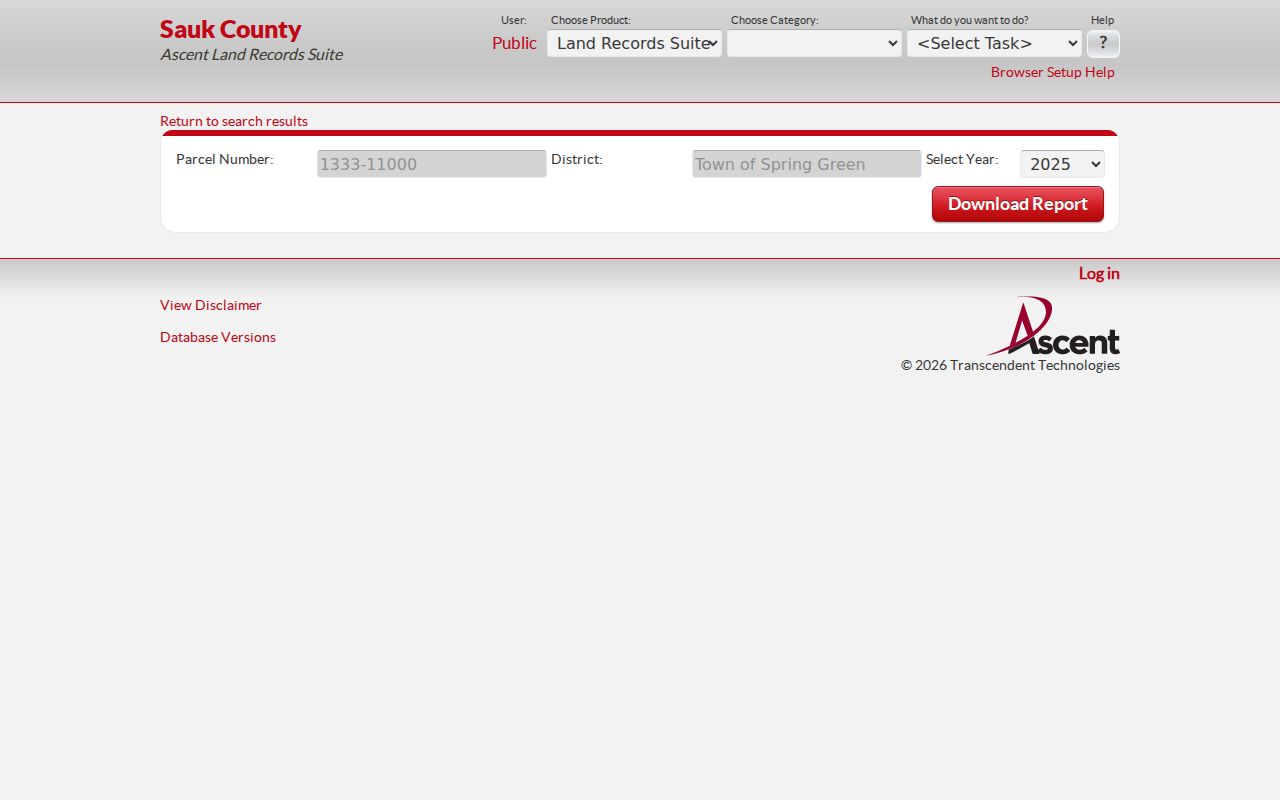
The public search route may still show a login or disclaimer screen. Open availability does not guarantee an unlocked detail image in Ascent.
Sauk County Assessment Ratios
Assessed value is the local value used for property taxation as of January 1. Assessment ratio compares an individual parcel's assessed value with fair market value. Assessment level compares a municipality's total assessed value with its equalized value. Wisconsin's DOR reports these measures by municipality. A 93 percent parcel ratio in the state manual's example comes from a $140,000 assessment divided by a $150,000 sale; it illustrates the math, not a Sauk County parcel.
The tax bill's estimated fair market value is generally found by dividing assessed value by the average assessment ratio. Taxes are levied on assessed value, not on that estimate. The DOR says major classes should be within 10 percent of full value at least once in a five-year period, with supervised revaluation possible for persistent noncompliance.
Sauk County Use-Value and Exemptions
Agricultural use-value property is the big exception when reading estimated market figures. The DOR guide notes a fair-market estimate. It may not appear for that class under the average ratio. Treat a blank field as blank. Comparing it to a residential parcel assumes methods that simply differ.
Sauk County publishes no complete local exemption list, current application form, or reassessment calendar. Check the parcel-year record. Also check current state or municipal instructions for any exemption or review question. A mailing-address change form filed with the Treasurer updates where tax and assessment mail goes. It does not touch situs, title, or ownership.
Finding a Sauk County Tax Bill
Begin in Ascent with the address or parcel number. Then follow the Treasurer's Property Tax Information link for bill and payment detail. Keep the year selected along with the parcel. Assessments move from one year to the next. For an in-rem foreclosure question, switch to the Treasurer's foreclosure explanation and Clerk of Court filings. Do not treat a tax bill as the whole case history.
- Find the parcel in Ascent and note municipality, parcel ID, and tax year.
- Open the Treasurer's tax information and check the bill and payment status.
- Compare the bill's assessment fields with that year's parcel detail.
- If delinquency is shown, check the county foreclosure page and court record.
- Assessed value
- The local tax value assigned to a parcel for the assessment year.
- Levy
- The amount raised by a taxing unit; a bill can include several units.
- Estimated fair market value
- A ratio-based bill estimate, not a sale offer or appraisal.
- Tax lien
- A recorded or statutory claim tied to unpaid tax; check the specific record.
The Sauk County Treasurer page links to tax information, payment, and foreclosure resources.
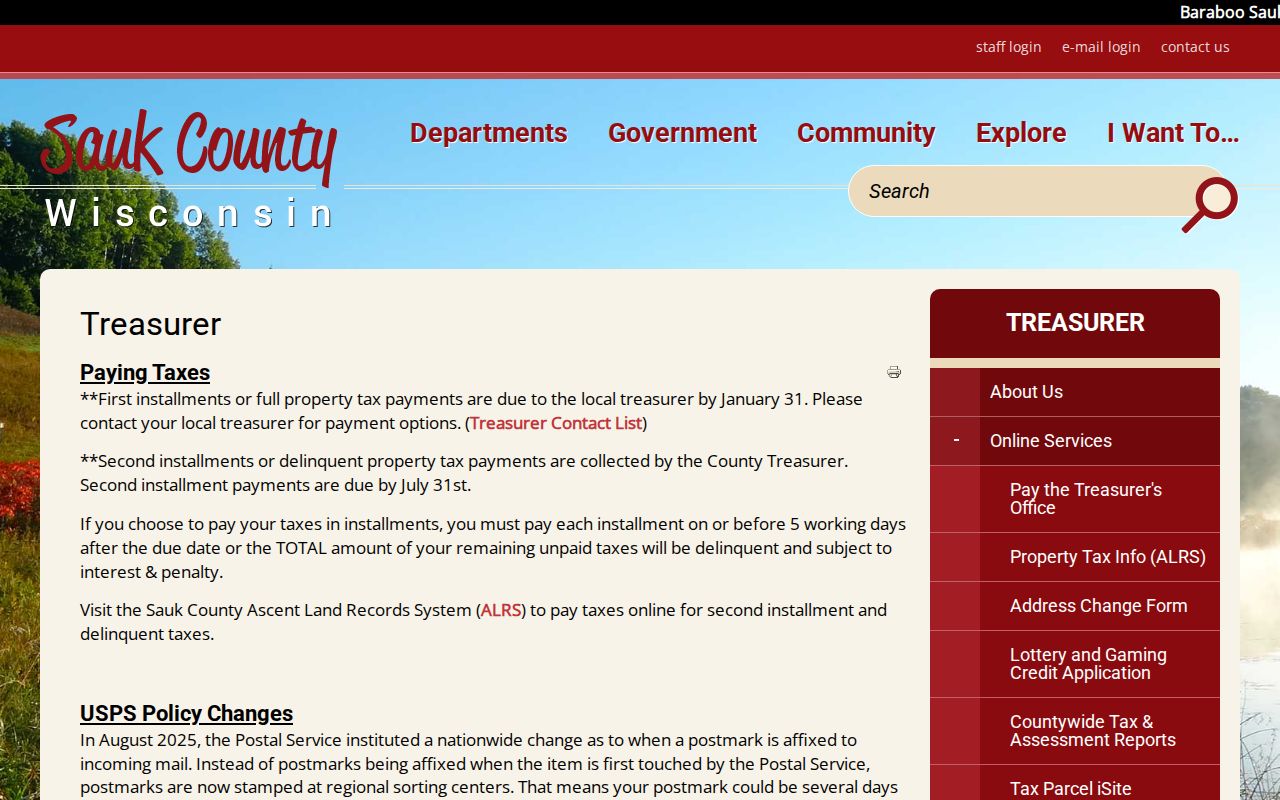
The Treasurer is the route to the bill; Ascent stays the parcel and assessment lookup. The two answer different questions.
The parcel-year screen is organized around assessment detail and tax year. The Treasurer's page ties a property account to billing and payment resources. A payment page may ask for a parcel or account key, so copy the full number, municipal prefix and leading zeros included. Never assume a map label alone will retrieve the right tax account in Sauk County.
Sauk County Delinquent-Tax Process
Tax foreclosure in Sauk County runs through the courts. The delinquent-tax list gets filed with the Clerk of Court. Notice then reaches owners, lenders, and any interested governments. Local newspapers publish the notice for three straight weeks. Redemption stays open for at least eight weeks after the first publication. To redeem, an owner must pay the delinquent taxes. Special charges, interest, penalties, and related amounts are also due. The Sauk County in-rem foreclosure page walks through redemption and the sealed-bid steps that follow.
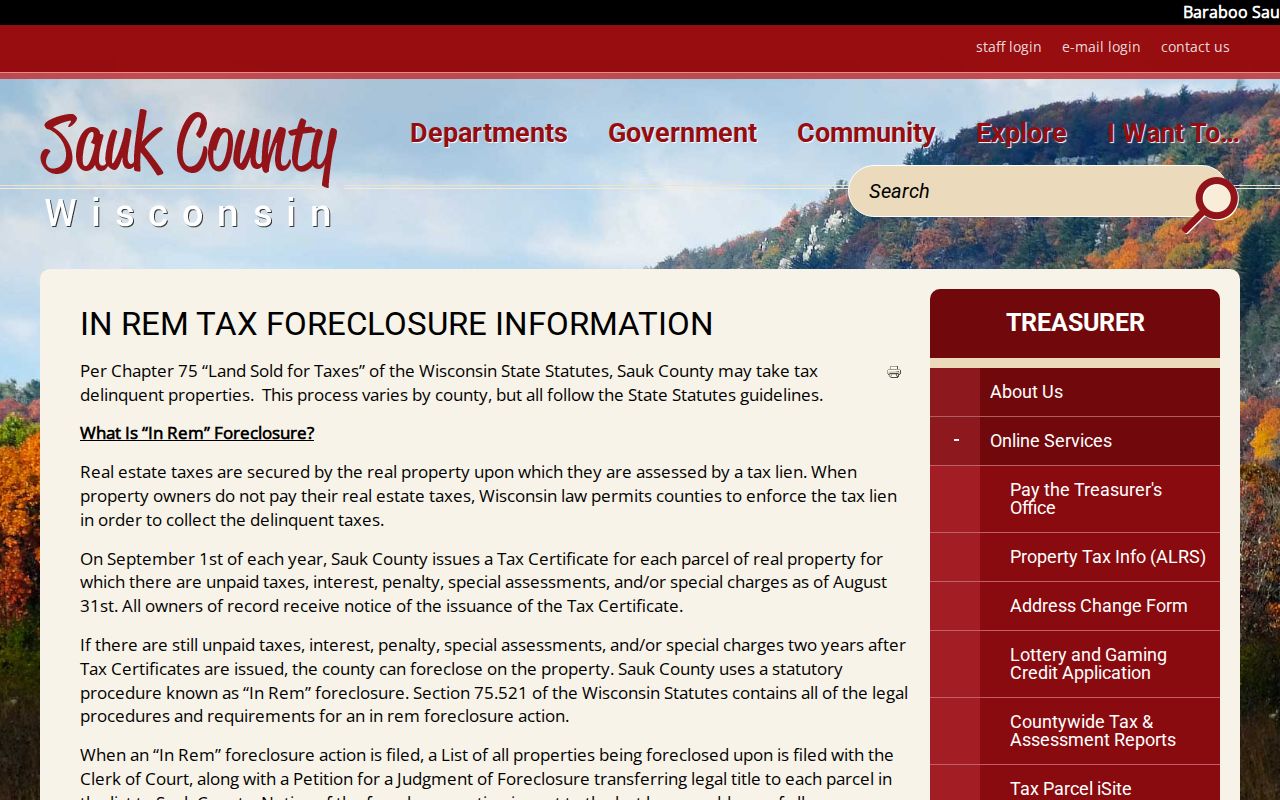
Once the county holds a foreclosed property, it may offer the parcel by sealed bid through county channels. The separate Sheriff sale list covers mortgage foreclosures, not the in-rem tax process.
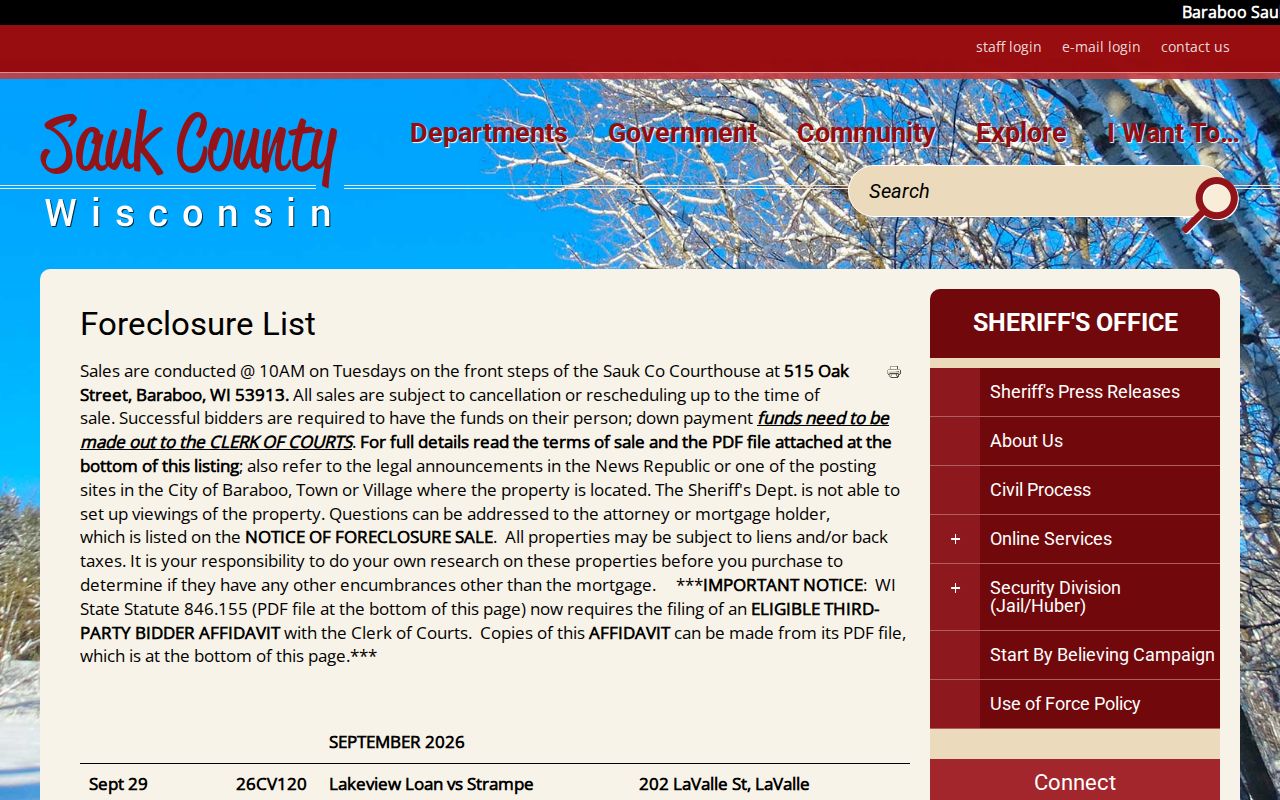
Always confirm status and sale terms in the current notice. An older list can mislead. In-rem tax foreclosure and a sheriff's mortgage-foreclosure sale are distinct processes, each with its own notices and custodians. The in-rem page describes newspaper publication and a redemption window of at least eight weeks after the first publication, while the sheriff sale list sets its own schedule and terms. A delinquent-tax entry alone is not the court disposition. A listed sale can also be cancelled or adjourned. Check the current notice and case record. Do not rely on an old calendar or a tax-year screen.
Sauk County Prior-Year Tax Records
The Ascent result shows which tax years are available. The detail route calls for a parcel, district, and year. Match the same parcel and year when you compare the assessment record against the tax bill. A year mismatch can make a value seem to jump. The property itself may not have changed at all. For the last sale, rely on the recorded deed or transfer data. Do not treat a tax figure as a price. An assessed value is a tax measure. The market estimate is ratio-based, and recorded consideration can be nominal. It can also be tied to a transfer that was not arm's length. The separate Sauk County property value record explains those distinctions in detail.
Reviewing a Sauk County Assessment
A property owner comparing an assessment should keep several documents together. These include the parcel card, the tax year, land and improvement values, and the DOR municipal assessment report. DOR publishes annual assessment levels, aggregate ratios, equalized values, and sales context. Those reports show the local measurement. But they do not decide whether one parcel is correctly valued. For open-book and Board of Review steps and dates, ask the local assessor or municipal clerk. Wisconsin's assessment cycle uses January 1 as the valuation date. That date anchors the assessment year. But it is not necessarily when a notice arrives or the objection deadline. Sauk County posts no single county-wide open-book schedule or appeal filing deadline. Check the notice for the municipality tied to the parcel instead. Keep dated photographs, permits, comparable sale details, and the parcel card at hand. The local process may ask for that supporting information.
Confirm the local calendar. A Sauk County-wide appeal date was not verified in the research. Use the current municipal notice and ask the assessor or clerk about the filing window, required objection form, and supporting sales evidence before the review period closes.