
What Sauk County Deed Records Show
A recorded deed in Sauk County identifies the parties, the instrument type, the recording date, and the legal description. It can move an interest into a person, a trust, an estate, or a company. The same office also records mortgages, satisfactions, assignments, liens, easements, restrictions, plats, and re-recordings. A party search may pull these up next to the deed you want. Not every one of them transfers ownership. Read the document type before you draw a conclusion.
| Deed Type | What It Does | Common Use |
|---|---|---|
| Warranty deed | Conveys the described interest with the promises written in the instrument. | Common transfer record; read its legal description and terms. |
| Quitclaim deed | Transfers whatever interest the signer holds, without a promise of full title. | Family, estate, or interest cleanup. |
| Personal representative or executor deed | Transfers property under estate authority. | Check the probate case and authority as well as the deed. |
| Trustee deed | Shows a transfer made by a trustee under the stated capacity. | Confirm the trust name and recording details. |
| Transfer-on-death instrument | Records a transfer direction that takes effect under its terms. | Read the recorded instrument and later transfer evidence. |
A deed conveys an interest. A mortgage secures a debt instead. Liens and easements affect the parcel in their own ways. A satisfaction or release can later clear a recorded claim. The grantor transfers; the grantee receives. In Sauk County, a matching party name is only one clue, so match the legal description and municipality before using any instrument in a title chain.
Sauk County LandShark Recordings
LandShark is the modern recording route for Sauk County real estate. It took over after the historical index period. The county Register of Deeds page links to its search endpoint. The Register publishes no confirmed details on image access, subscription terms, login gates, or result limits. Treat a visible index result and an obtainable image as separate things. When an image will not open from the public screen, contact the Register. The LandShark entry point is the county's linked modern recording system.
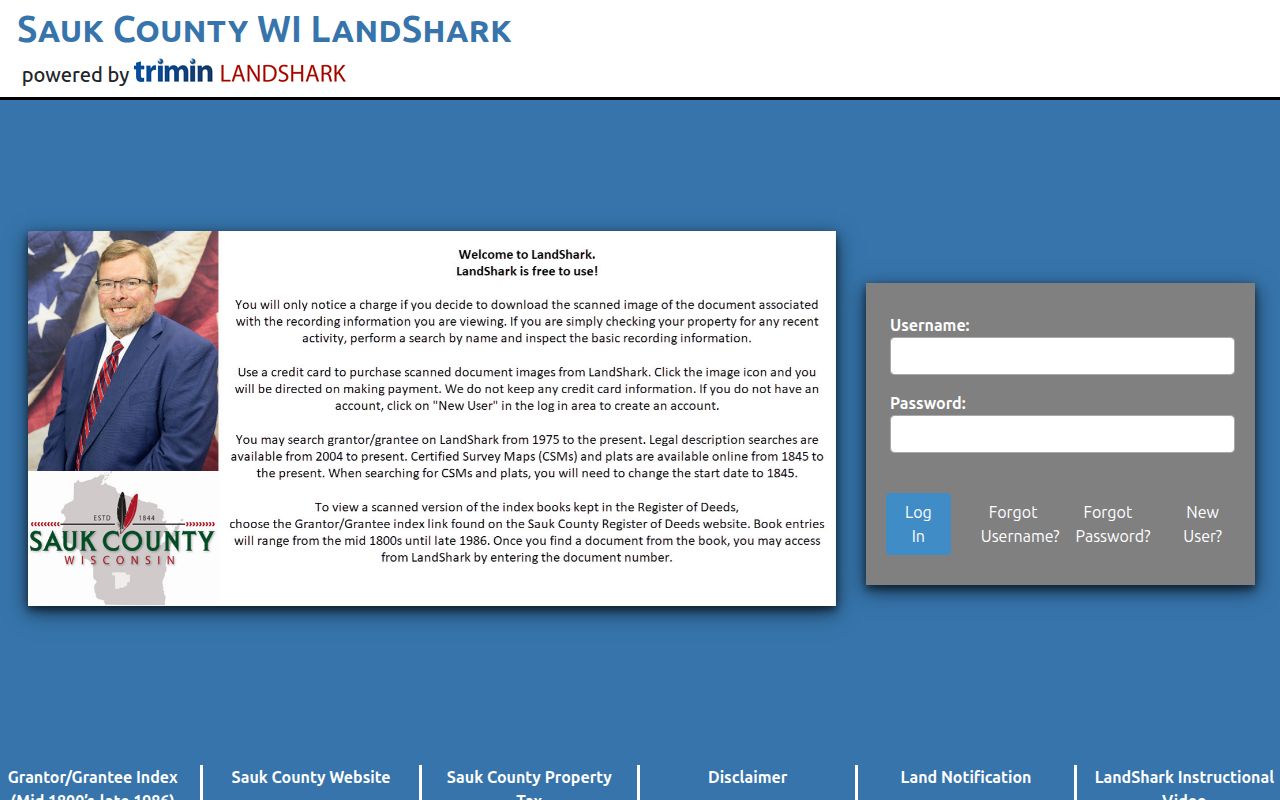
Record the instrument number or book and page reference before contacting the office.
Sauk County's Late-1986 Index Cutoff
Sauk County describes its historical Grantor/Grantee Index as covering the mid-1800s through late 1986. LandShark handles everything recorded later. That date is an index cutoff. It is not a promise that every historical deed image is digitized. The county was organized in 1840. Older chains may need original deed books, microfilm, a counter search, or archive help. The Register's historical index page links the older search and explains where to begin.
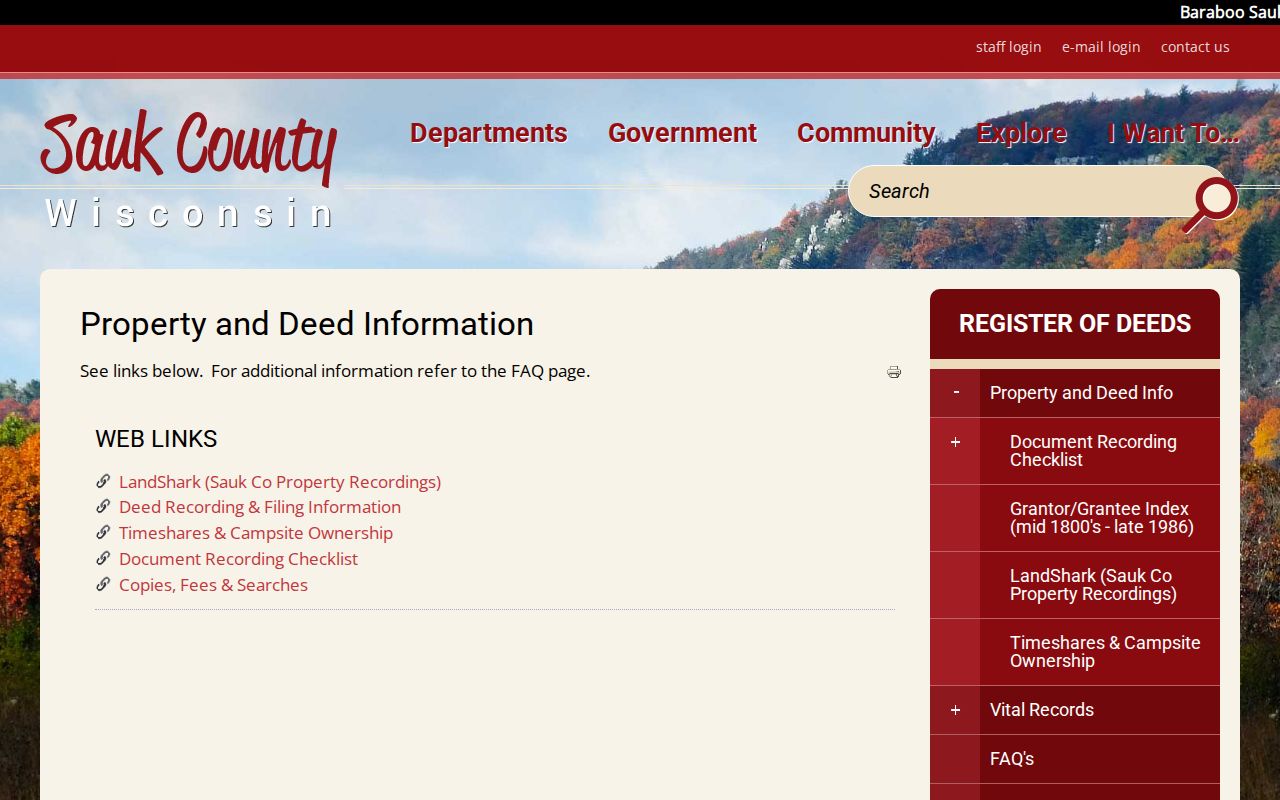
Older deeds often name lots, blocks, sections, or former municipalities rather than a modern street address. An address search can dead-end there. Pull the legal description from the current parcel card, then work backward through the party index. Today's parcel identifier may not appear on a nineteenth-century instrument, so the grantor, grantee, and land description become the bridge. Note the instrument date and the recording date separately. They can differ, and the index follows the recorded filing trail.
Sauk County Deed Index Fields
Typical search fields include grantor or grantee name, with ways to narrow by date, instrument type, document number, or book and page where the interface offers them. Not every LandShark control is documented publicly. The legal description remains the strongest check when an older entry lacks a parcel number.
| Index field | Type | What is known |
|---|---|---|
| Grantor or grantee | Name index | Search spelling variants and initials; required status not verified. |
| Recording date or year | Date filter | Historical index ends in late 1986; exact field options not verified. |
| Document number or book/page | Reference | Useful for requesting a copy; interface label not confirmed. |
| Document type | Category | Deeds and other recording types are held; full list not exposed. |
| Parcel or legal description | Cross-reference | May need to be read in the instrument rather than searched directly. |
Do not assume every field becomes a search box. If the online index will not expose the reference you need, give the Register the party, the approximate year, and the legal description.
Test names in the form used at recording time. A middle initial may be absent. A married name may differ from a prior entry. A company may have changed its legal name. Try reasonable variants, but keep each result separate until the municipality and legal description align. The goal is a document reference, not a conclusion that two index entries name the same person.
Reading Sauk County Grantor Names
The grantor-grantee index follows parties, not house numbers. Start with the current grantee on the latest deed. Read the prior grantor, then search that party as grantee to find the earlier purchase. Repeat by recording date and compare the legal description each time. Sauk County's older index may describe land with terms that predate today's address. They may also predate today's parcel number.
- Find the latest deed and identify the named grantee.
- Read the grantor and copy the legal description and instrument reference.
- Search the prior owner as grantee and compare the land description.
- Repeat until reaching the late-1986 cutoff, then use older indexes or books.
- Grantor
- The person or entity transferring an interest in a deed.
- Grantee
- The person or entity receiving the interest.
- Chain of title
- The ordered series of recorded transfers tied to the same land.
- Index versus image
- An index points to an entry; the image or certified copy is the instrument itself.
Sauk County Deeds and Liens
A Sauk County deed search may also return mortgages, assignments, satisfactions, and mechanic's liens. Judgment liens, tax liens, easements, restrictions, plats, and re-recordings can appear too. Each filing affects a different interest. Connect any satisfaction or release to the original mortgage or lien. Match them by parties, date, and parcel description. An old entry is neither active nor cleared until its later instruments are checked.
Foreclosure, quiet title, partition, and lien enforcement leave court trails too. Wisconsin Circuit Court Access searches public circuit-court cases online. Public terminals also sit at the courthouse. A docket can surface pleadings, a judgment, a sale confirmation, or a disposition. The recorded notice and instrument still need a Register of Deeds search.

A court case proves litigation happened. It does not settle who holds title. That distinction matters when you read deed records or lien filings in Sauk County.
Separate a filing's effect from its label, too. A mortgage secures a debt. An assignment moves that interest to a new holder. A satisfaction or release shows the debt was later discharged. Easements and restrictions can limit how a parcel is used. They do not change who owns the fee. The party trail in the deed records only means something when you read the document type and the legal description together.
Sauk County Recording Alerts
Sauk County runs a name-based notification service for real-estate filings. Supply a name. The service emails you when that name shows up in indexed records. A small record fee may apply. Treat an alert as a prompt. It is not title insurance or full parcel monitoring. When one arrives, compare it against the property you care about. Check the document type, recording date, parties, and legal description.
Deed-copy mailers can look official. They may still charge far more than the Register's posted copy price. The Sauk County Land Notification Service and the office fee schedule are the direct sources. They spell out this county's process.
For tracing ownership backward, the Sauk County former-owner records route covers the full chain. A single deed request just needs a party and an instrument reference.
Requesting a Sauk County Deed Copy
The Register of Deeds sits in Room 122 of the West Square Building. The address is 505 Broadway, Baraboo, WI 53913. A real-estate copy runs $2 for the first page. Each added page is $1, and certification adds $1. Recording a real-estate document costs $30 no matter the page count. Include a self-addressed stamped envelope to speed a mailed return. Confirm the current schedule before sending payment. The Sauk County copy and recording fee page lists the full schedule.
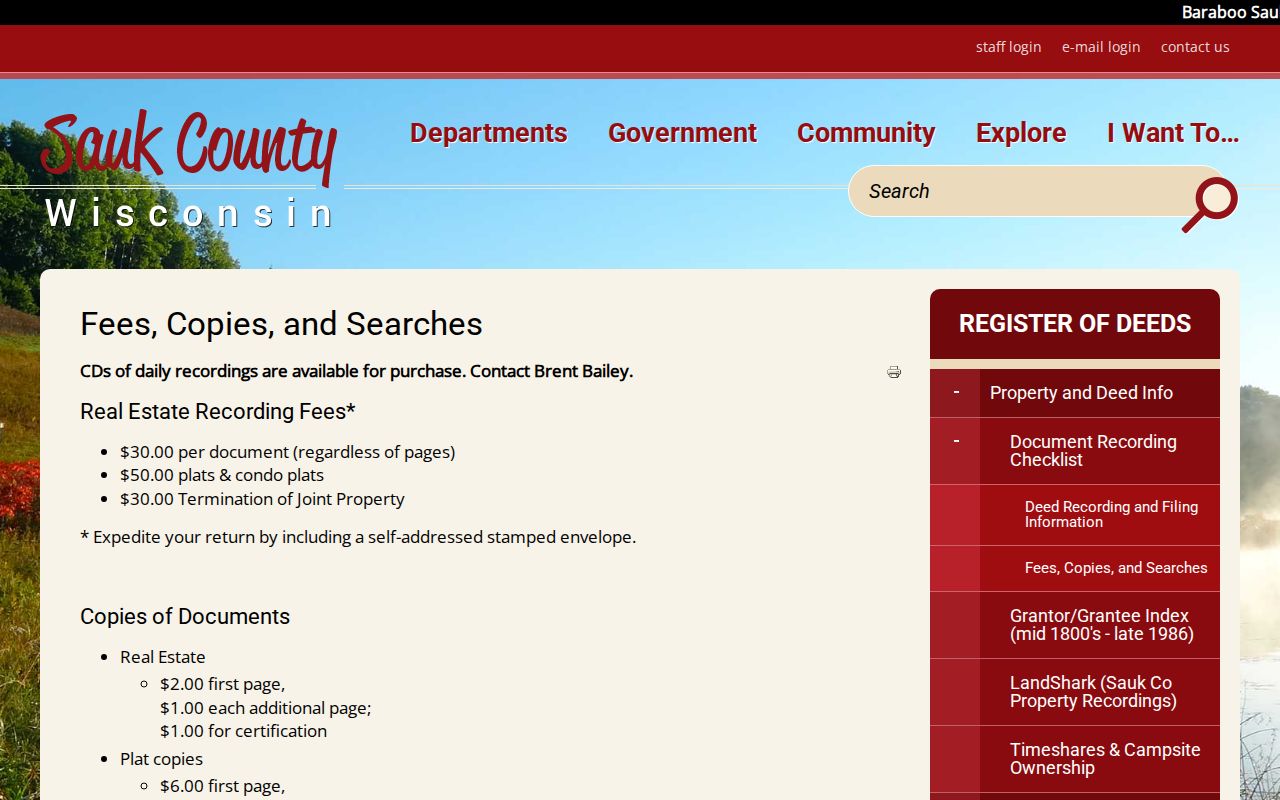
The Register's fee sheet splits recording costs from copy prices for documents already on record. The Register's copy-fee detail also separates ordinary real-estate copies from plats and certification.
Have your instrument number or book and page ready. Say up front whether you need a certified copy.
For recorded maps, the schedule sets a plat at $6 for the first page. It charges $3 for each additional page. A condominium plat costs $4 for the first page and $2 per added page. Those map rates sit apart from the $30 real-estate recording fee. The posted schedule controls current charges. Recheck the Register's fee page before you submit any copy request.
Recorded, not guaranteed. A Sauk County deed index shows what was recorded; it does not rule out an unrecorded interest or establish marketable title. A title professional checks the full chain.