
Values in Sauk County Property Records
A Sauk County property value record mixes several figures. A tax assessment, a ratio-based market estimate, and separate land and improvement fields can all sit on one parcel card. They are not interchangeable. A recorded sale belongs to the deed record, even when the assessor leans on that sale for an assessment ratio. Always read the field name and the year first.
| Value | What It Is | Where |
|---|---|---|
| Assessed value | Local value used as the property-tax base. | Ascent and assessment material. |
| Estimated fair market value | Ratio-based estimate when the bill or record prints it. | Tax bill or assessment record. |
| Recorded sale consideration | Consideration stated or reported with a transfer; not always arm's length. | Deed or transfer return data. |
| Land and improvements | Separate assessed components and their total. | Ascent parcel-year detail. |
Assessed value is set for taxation as of January 1. Wisconsin's assessment ratio compares one parcel's assessed value with fair market value, often using a usable arm's-length sale. Assessment level instead compares the municipality's total assessed value with equalized value. Those measures answer different questions and should not be swapped.
A parcel ratio and a municipal assessment level have different denominators. The Wisconsin manual's example of a $140,000 assessed value divided by a $150,000 sale yields about 93 percent for that parcel; the number is an illustration, not an observed Sauk County result. A DOR report can show whether a municipality's aggregate assessment level is close to equalized value, while the individual parcel card remains the source for the value assigned to one piece of land.
Sauk County Ascent Value Fields
Ascent's search result carries the essentials. It lists a parcel, owner or owners, site address, a privacy-expiration field, and the available tax years. Three inputs unlock a detail page. The parcel-year route asks for a parcel, a district, and a year. The county describes Parcel Info as showing basic assessment data, legal description, owner name, site address, and acreage, though a direct detail route may open on a login screen or disclaimer. Sauk County parcel-year detail shows the entry path.
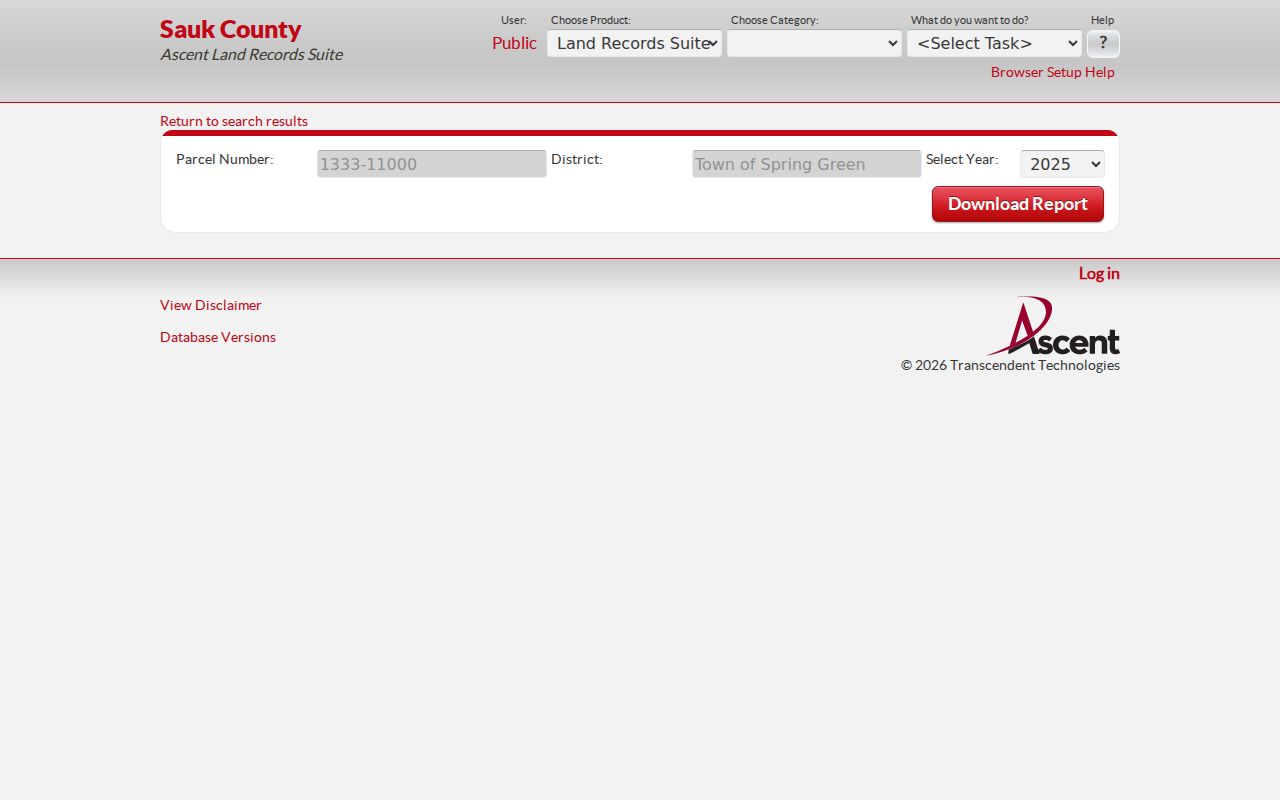
Always keep the tax year with the assessed amount. Values from different years are easy to compare by mistake. The result list reports which years exist. A direct detail path then asks for the parcel, district, and year you want. The year is part of the value, not a display preference. Save the municipality and parcel key as well. A new parcel split can appear in the system before its first full tax-year assessment, and the county warns that such a record may temporarily show $0.00. That placeholder is not a market estimate.
Sauk County Assessment Ratio and Level
The assessment ratio is a parcel-level comparison. The assessment level is a municipality-level one. It measures total assessed value against DOR equalized value. The Wisconsin manual's 93 percent example divides a $140,000 assessed value by a $150,000 sale. That arithmetic shows the formula. It is not a Sauk County parcel estimate. Each year the DOR publishes municipal reports with aggregate ratios, assessment levels, equalized values, and sales context. These describe overall assessment performance. They do not set a market price for any particular Sauk County property. State standards aim to bring major property classes within 10 percent of full value at least once in five years. Persistent noncompliance can trigger a DOR-supervised revaluation. That threshold tests overall uniformity rather than capping any single parcel's value. It also promises no fresh appraisal of every parcel in the same year, and Wisconsin DOR assessment reports give the municipality-level measures by year.
Sauk County Sale Price and Assessed Value
A last sale price comes from the deed or transfer instrument, not the assessor's card. Not every deed shows real money. Some state nominal consideration. Transfers between family members, entities, or other related parties may occur. These may not be arm's-length sales at all. DOR builds its sales-ratio data from real-estate transfer information. Yet a recorded consideration is still not a current market appraisal. Compare the sale date, recording date, parties, and parcel. Ask whether related parties were involved, and check the instrument type. The Sauk County deed records identify the recorded instrument. The price field still needs its own context.
Sauk County Annual Value Updates
Assessment runs on a January 1 valuation date. A new figure can reflect updated property data or a local revaluation. A deed records a transaction on the date it occurred. DOR reports annual submissions. It expects major classes to fall within 10 percent of full value at least once in a five-year period. Continued noncompliance can bring a supervised revaluation.
A sale does not trigger an immediate one-for-one change in the tax roll. The assessed amount, the municipal ratio, and sale evidence each update on their own schedules. Each serves a different purpose. Always check the year on a Sauk County record.
Sauk County Agricultural Use-Value
Agricultural land in Sauk County does not carry the standard fair-market display. Under use-value treatment, Wisconsin values farmland by how it is used, not by what a house lot might fetch. The state's property-owner guide puts it plainly: an estimated market figure may not be shown for this class using the average ratio. A blank value field is not the same as zero. Nor should an agricultural parcel be stacked against a residential one, since the methods simply differ.
That difference shows up in the property records themselves. Two Sauk County parcels with nearly identical acreage can display very different value fields because one falls in the agricultural class. The county GIS can help here, offering land-class and zoning reports for mapped categories. Treat those layers as context, though. The assessor's valuation decision lives in the assessment record, not the map.
Before comparing any land, note the parcel's classification and the tax year the record covers. Then ask the assessor or lister which valuation method was applied to that entry in the tax roll.
Looking Up Sauk County Property Value
Start in Ascent with an address or parcel number. Open the matching tax year, and save the parcel ID and municipality before you line up any values. When a sale offers a market reference, pull the deed separately and judge whether the transfer makes a fair comparison. A property value lookup reports numbers of record, nothing more. It is not a sale forecast.
- Search the site address or exact parcel in Ascent.
- Choose the municipality and tax year shown for the parcel.
- Record land value, improvement value, total, and any printed estimate.
- Check the deed for a sale record, then compare the dates and transfer type.
- Assessed value
- The value used as the local tax base.
- Market value
- An estimate of what a property could sell for under market conditions.
- Assessment ratio
- One parcel's assessed value compared with fair market value.
- Assessment level
- A municipality-wide comparison with equalized value.
- Recorded consideration
- The amount stated or reported in a transfer record, subject to context.
What Sauk County Assessed Value Is Not
Assessed value is a tax figure. In Sauk County it exists to spread the levy, and nothing more. It is not a market appraisal. It is not a price guarantee or a forecast of what a parcel would sell for. Divergence from a recent sale is normal. The assessment date, the mass-appraisal process, and the transfer date rarely align. For an opinion of market value tied to one property, hire a professional appraiser.
Value versus price. A Sauk County assessor value is for tax purposes, not a forecast of sale proceeds. The separate property tax record explains the bill and assessment context.